The EMN equips you with a broad understanding of neurotechnology, from fundamental research to clinical applications. Throughout the programme, you will develop your own ideas, learn how to translate them into practical solutions or entrepreneurial ventures, and gain a strong foundation in the legal, ethical, and societal dimensions of neurotechnology.
Beyond theoretical knowledge, EMN emphasizes hands-on experience: you will work with advanced technologies, carry out interdisciplinary projects, and gain practical skills that prepare you for careers in academia, industry, and start-ups.
By the end of the programme, you will not only be ready for the employers of the future but also part of an international community of neurotechnology specialists. Along the way, you will develop valuable skills in teamwork, communication, and leadership, essential tools for making an impact in science, innovation, and society.
What you will gain from EMN:
- A broad knowledge of neurotechnology, from basic research to clinical practice
- Practical experience with state-of-the-art technologies and methods
- Skills to develop and translate ideas into innovative solutions or start-ups
- An understanding of the ethical, legal, and societal implications of neurotechnology
- Interdisciplinary teamwork and project experience across STEM and neuro-medical sciences
- International and intercultural experience through mobility within Europe
- Career readiness for industry, entrepreneurship, healthcare innovation or academia
- A strong professional network of peers, researchers, and industry partners
1.3.1 Structure
The 120 ECTS credits required to successfully finish the Master’s degree programme are divided equally across the four semesters (see Figure 1).
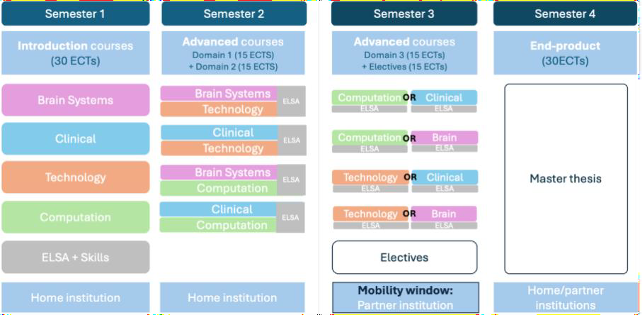
Semester 1 (30 ECTS): Foundations and Integration (Home University)
Each home university offers a set of core introductory courses covering all four domains, as well as ELSA (Ethical, Legal, and Social Aspects). These courses are delivered consistently across all partner universities. In total, they account for 30 ECTS, divided equally among the four domains Brain Systems, Clinical, Technology, and Computation, and ELSA. 1 ECTS is reserved for dedicated skills training, which will be taught in the form of workshops (e.g. for academic English, thesis/article writing, etc.). The first semester concludes with a challenge-based learning activity, allowing students to integrate knowledge across disciplines in response to a real-world problem.
Semester 2 (30 ECTS): Domain Specialization and Academic Innovation (Home University)
During the second semester, you will acquire advanced knowledge on two domains. Each partner university offers a unique combination of two domains, with each domain accounting for 15 ECTS:
Table 2: Domain combination that each university offers.
| University | Domain combination |
|---|---|
| Radboud Universiteit | Clinical and Technology |
| Universidad Miguel Hernández de Elche | Brain and Technology |
| Rheinische Friedrich-Wilhelms-Universität Bonn | Brain and Computation |
| Boğaziçi Üniversitesi | Clinical and Computation |
| Universitatea de Medicină și Farmacie “Iuliu Hațieganu” Cluj-Napoca | Clinical and Technology |
| Université de Lille | Clinical and Computation |
| Háskólinn í Reykjavík | Brain and Technology |
Each 15 ECTS module includes a 9 ECTS theory component, including theoretical courses (8.5 ECTS) and ELSA content (0.5 ECTS) and a 6 ECTS practical component, including practical classes (4 ECTS per domain) and a cross-domain workshop (2 ECTS per domain, 4 ECTS in total). This cross-domain workshop will implement challenge-based learning with a stronger focus on academic innovation. This workshop consists of a Challenge & Innovation Lab (3 ECTS, 1.5 ECTS per domain) and an ELSA mentorship program (1 ECTS, 0.5 ECTS per domain).
Semester 3 (30 ECTS): Mobility, Electives, and Industry Engagement (Partner University)
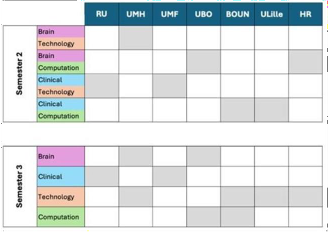
In the third semester, you will study at a partner university abroad, focusing on a (third) domain different from the ones taken in semester 2. In addition, you can choose from in-depth elective courses. The structure mirrors semester 2, with theory, practical, and ELSA components, as well as a workshop with a focus towards industry-driven challenges. In Figure 2 you seem which partner university teaches which domain in semester 2 and 3.
Note: The combination of domains in semester 2 influences mobility options in semester 3, since you are required to select a domain you have not previously studied.
Semester 4 (30 ECTS): Master’s Thesis (Home / Partner University)
In the fourth and final semester, you will focus on your Master’s Thesis (30 ECTS). The Master’s Thesis is designed to demonstrate your ability to conduct interdisciplinary research at the intersection of Brain Systems/Clinical and Computation/Technology domains. You will define a clear research question, grounded in a critical review of the scientific literature, and apply appropriate methodologies.
1.3.2 Curriculum
The curriculum is explicitly designed to foster interdisciplinarity by integrating neuroscience, engineering, clinical applications, and computational approaches. You will develop the ability to operate across disciplinary boundaries and apply integrative thinking to complex neurotechnology challenges. ELSA are not treated as standalone topics but are embedded across all domains. In addition to the introductory ELSA module in semester 1, each domain incorporates ELSA components in both theoretical and practical modules. A dedicated mentorship programme in semester 2 and 3 will support you in navigating ethical dilemmas encountered in research and innovation.
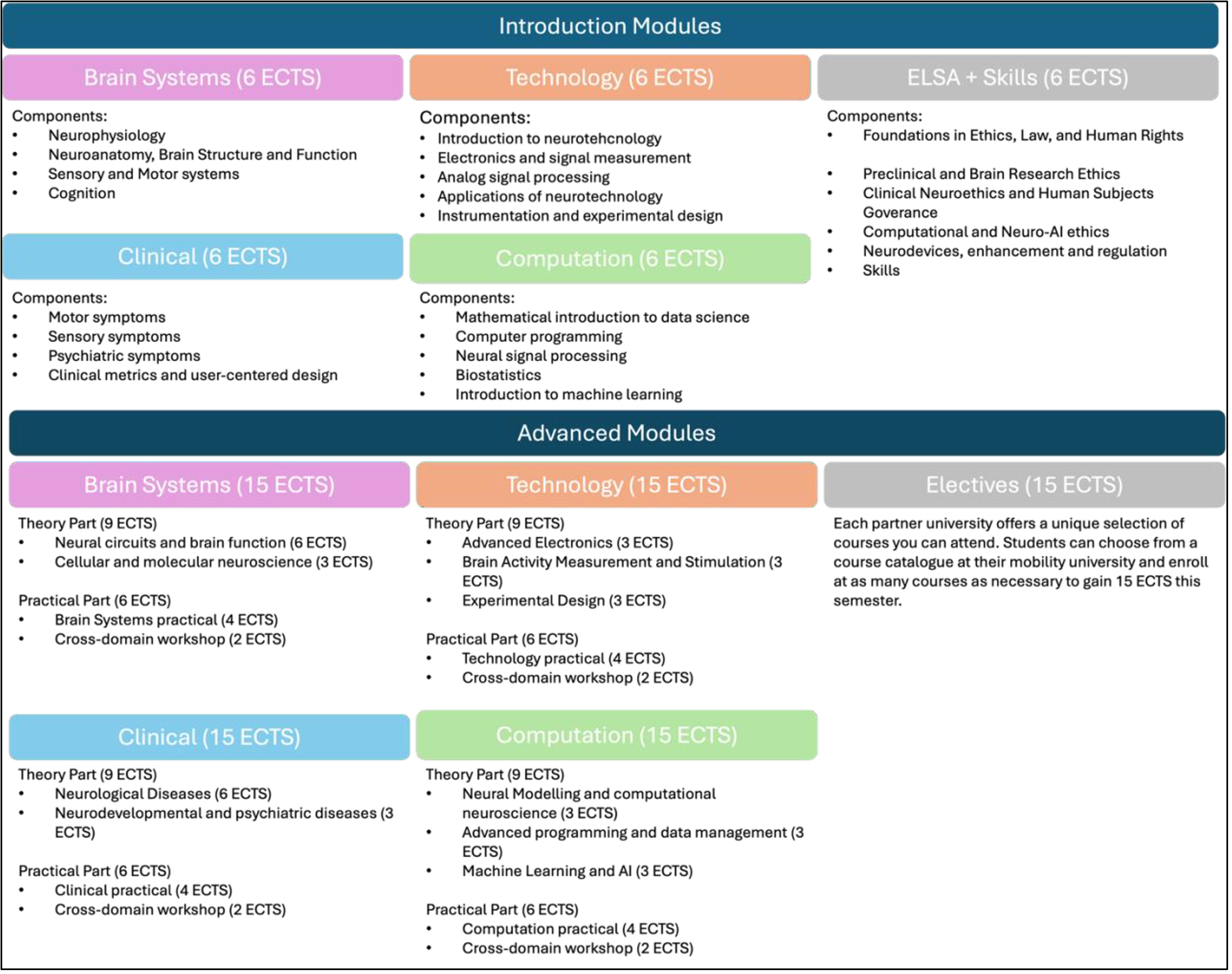
In Figure 3, you will find detailed information about the topics taught within each domain. The introduction modules in semester 1 primarily consist of lectures, complemented by practical elements. Their goal is to provide all students with the essential foundational knowledge required to understand the complex field of neurotechnologies.
The Advanced modules in Semesters 2 and 3 build on the knowledge gained during the first semester and provide deeper insight into three domains of neurotechnology. The first two domains are determined by your home institution, and the third domain is determined by the university chosen for your mobility semester. Regardless of your choices, modules in semesters 2 and 3 adopt a more practical approach, including interactive seminars, problem- and challenge-based learning exercises, and collaborative group work.
In semester 3, the electives at each partner university offer a unique selection of additional courses. Students can choose from the course catalogue and enrol in as many courses as needed to earn 15 ECTS. The catalogue is updated regularly, so please consult your university-specific information to stay up to date.
The Master’s Thesis in semester 4 marks the culmination of your academic journey. Here, you will integrate all your theoretical and practical knowledge into an independent research project.
Note: As this is a joint Master’s programme involving seven partner universities, each of you will have a unique academic journey, and specific subjects may vary, especially in mobility semester 3. If you have any questions or would like more information about your individual pathway, please contact your home university’s Local Academic Mentor—they will be happy to assist you.